Thursday, August 27, 2015
The Middle Ages - NOT so Dark an Age! (476 to 1400s)
From the Fall of the Roman Empire in the 5th Century (476) to the start of he Renaissance (15th century)

Wednesday, December 17, 2014
9 Tips for Teaching History
1. Wide, then Narrow: Before jumping into the finer
details of history, start by
 giving an overview, from beginning to end.
Knowing where the story is headed will give kids a better idea where the
details fit in.
giving an overview, from beginning to end.
Knowing where the story is headed will give kids a better idea where the
details fit in.
For example, when I teach Bible history I have the option of hundreds of different stories. If I start at the beginning and work my way through, my students will quickly get lost in the details. Instead, I break the entire Bible into six easy, yet central stories: Creation, Fall, Judgement (Flood), Promise (Abraham), Chosen People (Israelites), Cross (Jesus’ Sacrifice).
I strip these stories down to one or two simple details. I could literally tell each of these six stories in just a few sentences. This makes it easy for students to remember each story, and also to see how the stories fit together. The six stories then serve as bookends, and I simply go back and start filling in the gaps. I tell about Daniel and the Lions Den, and draw it back into the story of the Chosen People; I tell about Cain and Abel and point it to the Flood; I tie the Last Supper into the Story of the Cross. Teaching history this way keeps the stories connected.
2. Only Teach the Essential: If you are a mom who loves crafts, you may struggle with this one, but try to keep your content simple and relevant. If you are having your children dress up like turkeys to study the Pilgrims, you might be off track. The Pilgrims are not historical figures because they ate turkey!
3. Sequence, Not Dates: The order history unfolds is much more important than the actually dates (usually). If your history lessons become little more than the memorization of dates, your kids will learn to hate history. I’m not saying you can’t add dates, but again start with the basic elements of the story and then when your kids have mastered that, go back and sprinkle in the dates.
4. Explain BC and AD Early:
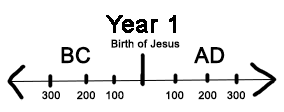 As soon as your kids are
old enough to understand the concept, explain the difference between BC
and AD. Be careful not to just say that BC is Before Christ and AD is
after His death. This confused me as a kid until learning that AD
started 30 years prior to Jesus’ death. Also, be sure to point out how
BC dates count backward; in other words, 3000 BC comes before 1,000 BC.
As soon as your kids are
old enough to understand the concept, explain the difference between BC
and AD. Be careful not to just say that BC is Before Christ and AD is
after His death. This confused me as a kid until learning that AD
started 30 years prior to Jesus’ death. Also, be sure to point out how
BC dates count backward; in other words, 3000 BC comes before 1,000 BC.
 5. Don’t be biased: For the most part, the history
taught in government schools is full of lies, misrepresentations, and
half-truths. When I was in elementary school I lived in Lawrence,
Kansas. During the Civil War, Lawrence was burned to the ground by
southern Border Ruffians.
5. Don’t be biased: For the most part, the history
taught in government schools is full of lies, misrepresentations, and
half-truths. When I was in elementary school I lived in Lawrence,
Kansas. During the Civil War, Lawrence was burned to the ground by
southern Border Ruffians.
The way I was taught it, the citizens of Lawrence were just sitting there singing kumbaya, when all of the suddenly those darn rebels burst into town on a murdering and raping spree. And I couldn’t help but think that all confederates were evil-murdering-rapists. In fact, many years later, I learned about the true “Jayhawkers” and the murderous raids that they ran in Missouri. In a town that loves its Jayhawks, it is no wonder they left that bit out.
It is in our nature to divide the history into a struggle of good versus evil, and paint everything either black or white. If our side commits atrocities they were justified; when the other guys do it, it’s always without cause. It is easy to fall into this type of deception. We often pick a side and then filter history accordingly, teaching only what we want to believe.
In most cases, history is a struggle between evil and evil; when we pretend otherwise, we champion propaganda, not history.
6. Use Real History: Whenever possible forgo the publishing houses’ textbooks, and use real historical words. Read works like The Bible, Herodotus’ Histories, Thucydides’ The History of the Peloponnesian War, Tacitus’ The Annals of Imperial Rome, and Caesar’s The Civil War. These books and others are real histories, and far more interesting than dry schoolhouse textbooks.
7. Not Every Old Story is History: History is an account of the events that dramatically changed the course of human destiny. What some ate, how they dressed, when they went to bed is closer to anthropology, than history. It does not matter how the Pilgrims dressed, what their boat was called, what time they went to bed, what their houses looked like, or what their favorite dessert was; these aren’t the reasons they are historical figures. We remember the Pilgrims, not for what they wore, but what they did, and more importantly, their impact.
8. Geography is the Canvas of History:
 It is hard to
understand history without a proper understanding of geography. You
will read, “Hitler invaded the Rhineland,” but you won’t know where that
was or why it was significant. The point is that geography allows us to
visualize the events as they occurred. That is why at Blue Manor we
begin teaching geography in kindergarten.
It is hard to
understand history without a proper understanding of geography. You
will read, “Hitler invaded the Rhineland,” but you won’t know where that
was or why it was significant. The point is that geography allows us to
visualize the events as they occurred. That is why at Blue Manor we
begin teaching geography in kindergarten.
9. Retell the Story: Never quiz your children on history with essays or bubble sheets. History is a story and as such, it is best to have your children retell the story in their own words.
Source: http://www.trueaimeducation.com/how-to-homeschool-history-9-teaching-tips/
For example, when I teach Bible history I have the option of hundreds of different stories. If I start at the beginning and work my way through, my students will quickly get lost in the details. Instead, I break the entire Bible into six easy, yet central stories: Creation, Fall, Judgement (Flood), Promise (Abraham), Chosen People (Israelites), Cross (Jesus’ Sacrifice).
I strip these stories down to one or two simple details. I could literally tell each of these six stories in just a few sentences. This makes it easy for students to remember each story, and also to see how the stories fit together. The six stories then serve as bookends, and I simply go back and start filling in the gaps. I tell about Daniel and the Lions Den, and draw it back into the story of the Chosen People; I tell about Cain and Abel and point it to the Flood; I tie the Last Supper into the Story of the Cross. Teaching history this way keeps the stories connected.
2. Only Teach the Essential: If you are a mom who loves crafts, you may struggle with this one, but try to keep your content simple and relevant. If you are having your children dress up like turkeys to study the Pilgrims, you might be off track. The Pilgrims are not historical figures because they ate turkey!
3. Sequence, Not Dates: The order history unfolds is much more important than the actually dates (usually). If your history lessons become little more than the memorization of dates, your kids will learn to hate history. I’m not saying you can’t add dates, but again start with the basic elements of the story and then when your kids have mastered that, go back and sprinkle in the dates.
4. Explain BC and AD Early:
5. Don’t be biased: For the most part, the history
taught in government schools is full of lies, misrepresentations, and
half-truths. When I was in elementary school I lived in Lawrence,
Kansas. During the Civil War, Lawrence was burned to the ground by
southern Border Ruffians.The way I was taught it, the citizens of Lawrence were just sitting there singing kumbaya, when all of the suddenly those darn rebels burst into town on a murdering and raping spree. And I couldn’t help but think that all confederates were evil-murdering-rapists. In fact, many years later, I learned about the true “Jayhawkers” and the murderous raids that they ran in Missouri. In a town that loves its Jayhawks, it is no wonder they left that bit out.
It is in our nature to divide the history into a struggle of good versus evil, and paint everything either black or white. If our side commits atrocities they were justified; when the other guys do it, it’s always without cause. It is easy to fall into this type of deception. We often pick a side and then filter history accordingly, teaching only what we want to believe.
In most cases, history is a struggle between evil and evil; when we pretend otherwise, we champion propaganda, not history.
6. Use Real History: Whenever possible forgo the publishing houses’ textbooks, and use real historical words. Read works like The Bible, Herodotus’ Histories, Thucydides’ The History of the Peloponnesian War, Tacitus’ The Annals of Imperial Rome, and Caesar’s The Civil War. These books and others are real histories, and far more interesting than dry schoolhouse textbooks.
7. Not Every Old Story is History: History is an account of the events that dramatically changed the course of human destiny. What some ate, how they dressed, when they went to bed is closer to anthropology, than history. It does not matter how the Pilgrims dressed, what their boat was called, what time they went to bed, what their houses looked like, or what their favorite dessert was; these aren’t the reasons they are historical figures. We remember the Pilgrims, not for what they wore, but what they did, and more importantly, their impact.
8. Geography is the Canvas of History:
9. Retell the Story: Never quiz your children on history with essays or bubble sheets. History is a story and as such, it is best to have your children retell the story in their own words.
Source: http://www.trueaimeducation.com/how-to-homeschool-history-9-teaching-tips/
Wednesday, October 29, 2014
Christopher Columbus

When the Knights of Columbus was founded 130 years ago, their namesake, Christopher Columbus, was a symbol of the idea that there is no contradiction in being a Catholic and an American. In recent decades, however, Columbus has become a figure of controversy, leaving conflicting opinions about his legacy.
Carol Delaney, a cultural anthropologist and long-time professor at Stanford University, had little knowledge or interest in Columbus — that is, until she was teaching a course called "Millennial Fever" at Stanford in 1999 and came across a reference to the explorer's apocalyptic beliefs. Delaney was intrigued and set out to research Columbus at Brown University in the summer of 2003. Two years later, she retired from Stanford to devote herself to research, which launched a remarkable journey in the footsteps of the explorer.
Columbia spoke to Delaney about the fruits of her research, published in her book titled Columbus and the Quest for Jerusalem (Free Press, 2011).
Columbia: You argue that most people misunderstand the purpose of Columbus' voyage. According to your research, what were his motivations?
Carol Delaney: Everybody knows that Columbus was trying to find gold, but they don't know what the gold was for: to fund a crusade to take Jerusalem back from the Muslims before the end of the world. A lot of people at the time thought that the apocalypse was coming because of all the signs: the plague, famine, earthquakes and so forth. And it was believed that before the end, Jerusalem had to be back in Christian hands so that Christ could return in judgment. Columbus actually calculated how many years were left before the end of the world. He seemed to think of his whole voyage as a mission, which was part of this apocalyptic scenario.
Columbia: In addition to funding the crusade, did Columbus intend to evangelize the New World?
Carol Delaney: He was very much interested in evangelizing. He wrote against the idea that the natives could just be baptized and automatically become Christian. Rather, they really needed to be instructed about the Christian faith before being converted. He wrote to the pope requesting that good priests be sent to provide this instruction and even left money in his will for it. Believing he was traveling to Asia, Columbus particularly wanted to convince the Grand Khan of China, who had already expressed interest in Christianity, to convert. He thought that the Grand Khan could help with the crusade to take Jerusalem by marching from the east, while the Europeans marched from the west — an interesting idea.
Columbia: Why don't more people recognize and accept your claims about Columbus' intentions?
Carol Delaney: Scholars have written articles about Columbus' religious motivations, but they were published in very arcane journals. In the 19th and early 20th centuries, historians wrote about Columbus as the first modern man, who used science and reason as an explorer and discoverer. But I don't think that was his motivation. He was a medieval man in a very religious context. He was very close to the Franciscans, who were involved in proselytizing before the end of the world.
Columbia: The popular view today is that Columbus is responsible for countless

Carol Delaney: No, not at all. The late 20th century brought a lot of critique about him from the perspective of the natives, and Columbus has become a symbol for everything that went wrong. But the more I read of his own writings and that of his contemporaries, my understanding of him totally changed. His relations with the natives tended to be benign. He liked the natives and found them to be very intelligent. He also described them as "natural Christians" because they had no other "sect," or false faith, and believed that they could easily become Christians if they had instruction.
Columbus strictly told the crew not to do things like murder or rape, and instead to treat the native people with respect. There are many examples in his writings where he gave instructions to this effect. Most of the time when injustices occurred, Columbus wasn't even there. There were terrible diseases that got communicated to the natives, but he can't be blamed for that.
A lot of the crew members didn't like all of the restrictions and rebelled. In his writings, Columbus notes that the crew assumed that they could have slaves, that they could pick gold off of the trees, and that they didn't have to work.
Columbia: What was Columbus' view toward slavery?
Carol Delaney: As far as I can tell, Columbus never had any slaves, nor did he intend to get slaves when he went across the ocean. There was no possibility of enslaving the Grand Khan and his people. And [Columbus] believed the natives would become subjects of the Spanish sovereigns.
When they later met a different group of natives, whom they believed to be cannibals, Columbus' brother sent some of these people back to Europe after their second voyage. It was considered morally acceptable at that time to enslave people who acted against their nature, with the hope that they would become good Christians. Slavery was common, even among people in the Caribbean. People ignore that fact and seem to think that Columbus instituted slavery.
Columbus strictly told the crew not to do things like murder or rape, and instead to treat the native people with respect.
Meanwhile, Bartolomé de Las Casas, an admirer of Columbus, is
remembered for writing in defense of the Indians. But unlike Columbus,
Las Casas owned slaves and operated encomiendas in the beginning. He
didn't have a change of heart until long after Columbus' death, and even
as late as the mid-16th century, he proposed slavery of African blacks
as a substitute for the Indians. Columbia: In your research, what did you find most significant about Columbus' own writings?
Carol Delaney: I read all of Columbus' writings that are extant. Columbus' original diary does not exist. Las Casas and Columbus' son, Ferdinand, each had a copy, and a lot of the story coincides in their redactions. Many of Columbus' writings express respect for the natives and concern about his crew.
Before I began my research, I didn't know Columbus had written anything. I liked the tone of his letters, and I enjoyed reading them. His devotion to his sons comes across, and he took care of the women in his life, which really helped change my opinion of him.

Columbia: In addition to his faith, what were some of Columbus' most notable personal qualities, and what role did they play in his quest?
Carol Delaney: I think he was very patient. He waited more than 10 years before his first voyage came about. He petitioned the Portuguese first, then the Spanish. The council rejected his proposal three times, yet he continued to persist. He really believed he could do it. He showed tremendous courage in going across the ocean in tiny wooden ships, with basically a compass to guide his way.
Also, when the crew was grounded on Jamaica during the fourth voyage, Columbus kept trying to negotiate with the rebels and expressed forgiveness.
Columbia: To what extent can Columbus' exploration be considered a failure or a success?
Carol Delaney: I think he went to the grave thinking that he had not accomplished what he wanted to do. He was angry with King Ferdinand for not pursuing the crusade, and he recognized that terrible crimes had been committed. From this point of view, he felt the quest was a failure. In reality, it was a major accomplishment. Columbus went across the ocean four times in small wooden ships, without the use of modern instruments. In the process, he discovered the New World, even though he thought that he had found only the periphery of Asia.

Acknowledgement
 |
The Author
Alton J. Pelowski is managing editor of Columbia and a 2006 graduate (M.T.S.) of the Pontifical John Paul II Institute for Studies on Marriage and Family at The Catholic University of America.Copyright © 2013 Columbia magazine
http://www.catholiceducation.org/en/culture/history/christopher-columbus.html
Another Columbus source:
http://www.catholiceducation.org/en/culture/history/the-origins-and-traditions-of-columbus-day.html
Thursday, August 15, 2013
Time Line Collection
Browse the
Past and some Futures... a collection of Timelines on the Web
History and Cultures
Science & Technology
Arts & Literature
Comments: George Emery
Sourceback Link: AlternaTime
 George Emery is a librarian at Canisius College and has been collecting timelines on
the Internet since 1993.
George Emery is a librarian at Canisius College and has been collecting timelines on
the Internet since 1993.
History & Cultures
Science & Technology
Arts & Literature
Popular Culture
Science Fiction
Home
History and Cultures
- Iraq Timeline
- Iraq History Timeline
- The Iraq Crises Timeline - MidEastWeb
- First Gulf War Timeline
- September 11, 2001: Timeline of Terrorism - InfoPlease
- Terrorist Attacks in U.S. Timeline - InfoPlease
- History of Terrorism : Timeline of Terrorist Acts
- Islam Chronology
- HyperHistory Collection of Timelines
- Timeline of the 20th Century
- The Wacky 20th Century Timeline
- American History Timeline - Smithsonian Institution
- Chronology of US Historical Documents - University of Oklahoma
- Timeline of U.S. Diplomatic History - U.S. Department of State
- Timeline of U.S. Presidents
- Abraham Lincoln Timeline - The History Place
- Theodore Rooselvelt Timeline
- America's Great Depression Timeline
- Timeline of the Great Depression
- Timeline of the Dust Bowl - PBS
- John F. Kennedy Photo History
- Ronald Reagan Timeline - PBS
- African American History Timeline
- Harriet Tubman Timeline
- African Timelines - Central Oregon Community College
- Timeline of South African Apartheid
- Chronology on the History of Slavery
- Timeline of the American Civil Rights Movement
- A W.E.B. Du Bois Chronology
- Minority Events in Los Angeles Timeline
- Jackie Robinson Timeline
- Suffrage Movement Timeline
- A Timeline of the Women's Rights Movement
- History of Womem in Sports Timeline
- Hispanic World History Timeline
- Mexico: Splendors of Thirty Centuries - Timelines
- People and History of Mexico Timeline
- History of Cuba Timeline
- Chronology of Western and Central Europe
- A Timeline of Irish History
- Celtic History Timeline
- Timeline of the Celts
- A Political Timeline of the Irish Colonial Experience
- A Scots Historical Timeline
- Scotland Timeline
- Timeline of Scotland's Royal Stuart Dynasty
- Medieval Wales Timeline
- Timeline of British History
- Chronology of Russian History
- Romanov Timeline
- Timeline of Japanese History
- Silk Road Timeline
- Chinese American History Timeline
- Chinese Emperors Timeline
- Timeline of Tibet
- Tibet Timeline
- Timeline of Buddhist History
- Tibetan Buddhist Text Chronology
- Timeline of India
- Timeline of India's Freedom Struggle
- Timeline of Ganhdi's Life
- Timeline of India's History
- Timeline of Medieval India
- Chronology of Mogul Emperors
- Timeline of Sikh History
- Timeline of Indonesia
- Chronology of Different Civilizations in Syria
- Chronological History of Cyprus
- Timeline of Iranian History
- Timelines of Egypt
- Timeline of Ancient Egypt
- Qumran Timeline of the Dead Sea Scrolls incorporating Egyptian, Israelite, Assyrian, Babylonian, Hittite, Persian, and Roman Reference Timelines
- Timeline of the Old Testament - from Noah to Ezra
- Mesopotamian Timeline
- Mesopotamian Timeline 2
- Timeline of the Hittites
- Timeline of Ancient Rome
- Ancient Greek Timeline
- Timeline of the Byzantine Empire
- Timeline of Carthaginian History
- Viking Timeline
- Italy: A Timeline
- History of France Timeline
- Timeline of the Civil War in France
- Yugoslavia Timeline
- Medieval Spanish History Timeline
- Medieval Timeline
- Timeline of Medieval Europe
- 14th Century Timeline
- Timeline of the Inquisition
- Ancient & Medieval Church History Timeline
- Chronology of Christianity
- Pope Joan Timeline
- Timeline of the Renaissance
- Timeline of World Religions - Eastern
- Timeline of World Religions - Western
- France During the French Revolution and Under Napoleon Bonaparte
- Chronology of the Napoleonic Wars
- Trenches on the Web Timeline (World War I)
- League of Nations Fight - A Chronology
- Rise of Adolf Hitler Timeline
- World War II Timeline - University of San Diego
- World War 2 Timeline
- Timeline of Selected Events 1931-1945
- Patton Timeline
- Berlin Wall Timeline
- Holocaust Timeline
- Jewish History Timeline
- Timeline for the History of Judaism
- American Jewish History Online Timeline
- History of Jerusalem Timeline
- History of Jerusalem Timeline - The History Channel
- History of Jerusalem Timeline - World Zionist perspective
- Timeline of Ethiopian Jewish History
- Timeline of Romani (Gypsy) History
- Chronological Table of Nuclear Weapons
- Anarchist Timeline
- Hippie Movement Timeline
- U.S. Civil War Timeline (History Place)
- Lewis & Clark Timeline
- Age of Exploration Timeline
- Christopher Columbus Timeline
- Native American Timeline
- Navajo Timeline
- Cherokee Timeline
- Timeline of Events Relevant to the Northern Plains Tribes
- Blackfeet Timeline
- Comanche Timeline
- Chicago Timeline
- New York Timeline
- Roosevelt Island, NYC Timeline
- Timeline of New York City Disasters
- Coney Island Timeline
- Philadelphia Timeline
- Liberty Bell Timeline
- San Francisco Timeline
- Alcatraz Island: Military Timeline
- Yellowstone Timeline
- Texas History Timeline
- Timeline of New Mexico History
- Salem Witch Trials 1692 Chronology
- Sociology Timeline
- History of Psychology Timeline
- Sears' Queer History Timeline
- Timeline of Lesbian and Gay History
- The American Gay Rights Movement: A Timeline
- Gay and Lesbian Timeline - The Advocate
- Gays and Religion Timeline
- People with a History: An Online Guide to Lesbian, Gay, Bisexual, and Trans* History - Fordham University
- Timeline of the Marquis De Sade
- Philosophers Timeline
- A Timeline of Western Philosophers
- Chronology of Scholarly Societies
- Timeline of Famous Economist
- Regnal Chronology - Rulers of the world by geography
Science & Technology
- Science Timeline
- Chronology of Scientific Developments
- History of Science and Technlogy Timeline
- Events In Science, Mathematics, and Technology - Timelines
- Strange Science Timeline
- An Illustrated Speculative Timeline of Future Technology and Social Change
- Atomic Structure Timeline
- History of Mathematics Timeline
- A Time Line of Mathematicians
- Timeline of Computing History
- Chronology of Personal Computers
- Popular Computer Programming Languages Timeline
- Artificial Intelligence Timeline
- Hobbes Internet Timeline
- Timeline of Net Related Terms and Concepts
- Timeline of Spam Related Terms and Concepts
- HyperTerrorist's Timeline of Hypertext History
- Nuclear Age Timeline
- Atomic Bomb Chronology, 1945-1946
- Environmental Conflict Timeline
- Evolutionary and Geological Timelines
- Timeline: Major Events in the U.S. Genome Project
- Plant Trivia Timeline
- Galileo Timeline
- Aviation Timeline
- Female Aviation Firsts - Female Frontiers
- Charles Lindbergh Aviation Timeline
- Space Program Timeline
- Hubble Space Telescope Weekly Timelines
- Chronology of Lunar & Planetary Exploration
- NASA Timeline
- Timeline of the NASA Space Program
- Apollo 11 Timeline
- Comet Hale-Bopp Timeline - 1997
- Film Sound History Timeline
- A U.S. Television Chronology, 1875-1970
- TV Timeline
- Chronology of Book History
- Global Networking: a Timeline 1000-1799
- Science of Cycling Timeline - Exploratorium, S.F.
- Chronology of the Chevrolet Corvettes
- Triumph Motocycles Timeline
- Alchemical Timelines
- Sex Science Timeline
- Diabetes Timeline
- Timeline: A Brief History of AIDS/HIV
- Timeline of HP Calculators
- Timeline of Inventions from Bell Laboratories
- Events in the Life of Vannevar Bush
- Architecture Timeline - includes World and American
Arts & Literature
- Pulitzer Prizes
- WebMuseum Timeline
- Metropolitan Museum of Art's Timeline
- Chronology of Japan's Fine Arts
- Timeline of Indian Art
- Romantic Chronology
- Timeline of Composers
- Timeline of Classical Music
- Renaissance & Baroque Music Chronology
- Shakespeare Timeline
- Charles Dickens Timeline
- A Time-Line of English Poetry 658-2000
- What The Thunder Said: T.S. Eliot Timeline
- The Tolkien Timeline
- A History and Complete Chronology of Numenor (Tolkien)
- Lovecraftian Timeline
- William Faulkner Chronology
- Brief Timeline of American Literature and Events Pre-1620 to 1920
- WPA Think Tank Timeline
- The Irish Literary Renaissance
- Timeline of James Joyce's Life
- The Mary Wollstonecraft Shelley Chronology
- Kurt Vonnegut Chronology
- Copyright Law Timeline
- Harry Potter Timeline
- Harry Potter Fan Zone Timeline
- Life and Times of Andy Kaufman
- Elian Gonzalez Timeline in Pictures - BBC
- Princess Diana Timeline
- A Timeline of Diana's Life
- Timeline of Toys & Games
- The History of Gardening: A Timeline From Ancient Times to the 20th Century
- Espresso Timeline
- A Cocktail Time Line - About.com
- Food Timeline
- McDonald's Timeline
- History of Tobacco
- Cold War Fashion Timeline (CNN)
- A Comparative Chronology of Money
- Elvis Presley Biographical Timeline
- Elvis Timeline
- Beatles Timeline
- Beatles Recording Timeline
- Rolling Stones Timeline
- Jimi Hendrix Timeline
- Jefferson Airplane/Starship Timeline
- Paul Simon Timeline
- Pink Floyd Timeline
- Captain Beefheart & His/The Magic Band
- Movie Timeline
- James Dean Memorial Timeline
- Spinal Tap Timeline
- Ferris Bueller Timeline Problem
- The Vampire Chronicles Timeline
- Twin Peaks Timeline
- Buffy the Vampire Slayer Chronology
- History of Xena: Warrior Princess
- DC Universe Timeline
- The Fleischer Superman Cartoons
- Santa Claus Timeline
- Chronology of the Martial Arts
- North American Hockey Timeline
- Timeline of Major League Baseball
- Science Fiction Timeline
- Chronology of the History of Science Fiction
- Time Tales: A Star Wars Chronology
- Heinlein Timelines
- Planet of the Apes Timeline
- Back to the Future Time Travel Chronology
- Jerry Pournelle Chronology of Future History
- BattleTech Timelines
- Anime Timeline
- X Files Timeline
- Doctor Who Chronology
- The Doctor's Timeline (Doctor Who)
- Isaac Asimov Encyclopedia Galatica Timeline
- The Transformers Chronology
- Power Rangers Timeline
- Babylon 5 History Page
- Godzilla Chronlogy
- Top
Comments: George Emery
Sourceback Link: AlternaTime
History & Cultures
Science & Technology
Arts & Literature
Popular Culture
Science Fiction
Home
Wednesday, August 14, 2013
The Electoral College
The Electoral College

http://www.congressforkids.net/Elections_electoralcollege.htm
Did
you know that voters in the United States don't vote for the president?
People actually vote for a group of electors when they go to the
polls on Election Day. These electors have pledged to support a
party's nominee for president. In many states the ballot lists only
the names of the nominees and not the names of the electors, so
many people believe they are voting for the president.
In 1787, the
delegates to the Constitutional Convention decided on this system
of indirect election of the president. Long debates took place about
how to make sure the best candidate would be chosen as president.
Some delegates supported a direct election by citizens. Others favored
having Congress choose the president. Still others thought that
state legislatures should make the choice.
The delegates
finally agreed on a compromise. Electors chosen by each state would
elect the president. Ordinary citizens in each state would have
a say this way, but the final decision would be made by people who
were better informed about the candidates and the issues.
The Electoral
College, this system of presidential electors, is still in effect
today, although some adjustments have been made over the years.
The electors voted for two candidates at first. The one with the
highest number of votes became president. The one with the second-highest
number became vice president. In 1796, political foes were chosen
for the two posts -- Federalist John Adams for president and Democratic-Republican
Thomas Jefferson for vice president.
There was a
tie between Thomas Jefferson and Aaron Burr in the next election.
The House of Representatives had to decide who would be president.
The fact that the system needed to be adjusted was clear. The 12th
Amendment to the Constitution was passed in 1804. Candidates are
now nominated to run only for president or only for vice president.
Electors vote for president and vice president separately.
How the states elect
electors has changed, too. Some states held direct popular elections
for the electors in the beginning. The state legislatures made the
choice in other states. All the states gradually adopted direct
popular elections for electors.
There were no political
parties when the Constitution was written. They soon developed,
and the party organizations in each state began proposing a slate,
or list, of electors who were pledged to vote for their party's
nominee. Voters no longer choose individual electors. Voters choose
between party slates.
Political parties
want winner-take-all elections for electors. This means that the
slate that receives the most popular votes wins all the state's
electoral votes. All the states except Maine use this winner-take-all
system today.

 Show What You Know
Friday, June 8, 2012
Preamble with Words & Original
Hey, do you know about the U.S.A.?
Do you know about the government?
Can you tell me about the Constitution?
Hey, learn about the U.S.A.
In 1787 I'm told
Our founding fathers did agree
To write a list of principles
For keepin' people free.
The U.S.A. was just startin' out.
A whole brand-new country.
And so our people spelled it out
The things that we should be.
And they put those principles down on paper and called it the Constitution, and it's been helping us run our country ever since then. The first part of the Constitution is called the preamble and tells what those founding fathers set out to do.
We the people,
In order to form a more perfect union,
Establish justice, insure domestic tranquility,
Provide for the common defense,
Promote the general welfare and
Secure the blessings of liberty
To ourselves and our posterity
Do ordain and establish this Constitution for the United States of America.
In 1787 I'm told
Our founding fathers all sat down
And wrote a list of principles
That's known the world around.
The U.S.A. was just starting out
A whole brand-new country.
And so our people spelled it out
They wanted a land of liberty.
And the Preamble goes like this:
We the people,
In order to form a more perfect union,
Establish justice, insure domestic tranquility,
Provide for the common defense,
Promote the general welfare and
Secure the blessings of liberty
To ourselves and our posterity
Do ordain and establish this Constitution for the United States of America.
For the United States of America...
Note:
The lyrics here have a slightly abridged wording of the Preamble to the United States Constitution. The actual document starts, "We the people of the United States, in order to form a more perfect union..."
A Promise of Freedom (12 minutes)
Department of Homeland Security
U.S. Citizenship and Immigration Services
Produced by the National Constitution Center
Subscribe to:
Posts (Atom)